Showing posts with label Bulgaria. Show all posts

Saturday, July 19, 2025

Back to Bulgaria!


I'm excited to be heading back to Blagoevgrad, Bulgaria, in just a few days to kick off the FIFTH edition of the MUSE Academy program sponsored by the America for Bulgaria Foundation (ABF).

The MUSE Academy will equip Bulgarian professionals from museums and other cultural organizations with the tools to create compelling exhibits and tell powerful stories that will keep visitors returning for more.

I am doubly excited to share the MUSE Academy teaching stage with colleagues Isabella Bruno and Christina Ferwerda!

Also check out this article from the ABF website, which shares more information about my work and the MUSE Academy. Follow me on Facebook and Instagram, where I will post live updates from Bulgaria!


Don't miss out on any ExhibiTricks posts! It's easy to get updates via email or your favorite news reader. Just click the "Sign up for Free ExhibiTricks Blog Updates" link on the upper right side of the blog.

Paul Orselli writes the posts on ExhibiTricks. Paul likes to combine interesting people, ideas, and materials to make exhibits (and entire museums!) with his company POW! (Paul Orselli Workshop, Inc.) Let's work on a project together!

If you enjoy the blog, you can help keep it free to read and free from ads by supporting ExhibiTricks through our PayPal "Tip Jar"

Friday, June 14, 2024

Bringing Dark History to Light


In the past few months, I had two interconnected experiences related to Belene, a forced labor camp in Bulgaria.

Belene was a prison camp in northern Bulgaria on an island in the Danube River that was active from approximately 1949 to 1987.  Belene was one of the places where the Bulgarian regime would send dissidents or just about anyone who disagreed publicly with the policies of Bulgaria's socialist state.

This past March, I had the opportunity to tour with a local volunteer guide the site of the former Belene camp, a remote natural area filled with decaying buildings that are slowly being interpreted and restored.  It's a bit of a strange experience since a penitentiary still operates in the western part of the island, while the eastern part is a managed natural reserve filled with pelicans and other wildlife.


Of course, being in a place where so much human tragedy occurred is a deeply moving experience. But how do you interpret the stories from such a remote place? And how do you push against many people's reluctance to bring up such painful memories from Bulgaria's past?

Enter the Sofia Platform Foundationa non-governmental organization. One part of the Foundation's mission is focused on "promoting remembrance and dealing with the communist past through historical dialogue and education."

To that end, I recently visited a pop-up exhibition entitled “Belene—A Bulgarian Resistance Story” in Washington, D.C. The exhibition drew upon hours of video interviews with Nikola Daskalov, a Belene camp survivor. The exhibit experience provided visitors with the unique opportunity to have a "conversation" with Mr. Daskalov through an interactive AI-driven video system.


The exhibition is one part of the Belene Camp project < 
www.belene.camp >, an effort of the Sofia Platform Foundation, with the support of the America for Bulgaria Foundation, to preserve the memory of Bulgaria's totalitarian past using state-of-the-art technology.

And isn't bringing the past, even the painful and uncomfortable past, into the light of the present in new and engaging ways an essential part of our museum work?  

I urge you to visit all of the organizations' websites linked above to learn more about their important work, including opportunities to "converse" with Belene survivors via a Web interface.


Don't miss out on any ExhibiTricks posts! It's easy to get updates via email or your favorite news reader. Just click the "Sign up for Free ExhibiTricks Blog Updates" link on the upper right side of the blog.

Paul Orselli writes the posts on ExhibiTricks. Paul likes to combine interesting people, ideas, and materials to make exhibits (and entire museums!) with his company POW! (Paul Orselli Workshop, Inc.) Let's work on a project together!

If you enjoy the blog, you can help keep it free to read and free from ads by supporting ExhibiTricks through our PayPal "Tip Jar"

Saturday, April 6, 2024

Learning About Creative Partners in Bulgaria!


I've just returned from Pleven, a city in northern Bulgaria, where I helped lead a week-long series of professional development workshops (called MUSE Academy) for Bulgarian colleagues working in museums and allied cultural organizations across the country.

One of the things I've been thinking about after this most recent trip to Bulgaria is how to recognize the four qualities that make great Creative Partners.

For me, the best Creative Partners are the ones that 1) Have Fun; 2) Think Big;  3) Work Flexibly; and 4) Get Stuff Done.  Below are some of the ways that the MUSE Academy fostered Creative Partners, and the four qualities below are important indicators to keep in mind when working with partners on any creative and challenging project.


1) Have Fun
My memories of working with my two MUSE Academy co-instructors, Christina Ferwerda and Jamie Lawyer, are filled with laughter.  We all really believe in working hard during our trips to Bulgaria, with extensive planning ahead of time. And yet, our work is enjoyable because we have fun together.


2) Think Big 
Our creative partners at the America for Bulgaria Foundation sponsor the MUSE Academy, and we are so lucky to have Nadia Zaharieva and Yuliana Decheva as the point people from the Foundation driving everything forward.  Nadia and Yuliana push us to "think bigger" and to create more opportunities for the MUSE Academy participants, in turn building even greater capacity in the Bulgarian museum and cultural sectors.


3) Work Flexibly
Unexpected events occur in every project I've worked on. Our time in Pleven was no exception, as a few "Bulgarian surprises" came up during our week there. Despite this, I was sure that my Creative Partners would be flexible and figure out ways to overcome any challenges rather than complaining or pointing fingers.


4) Get Stuff Done 
Можело is a Bulgarian word meaning roughly, "This can be done!"  We strive for a spirit of Можело during our week together with MUSE Academy participants -- to push against the notion of "This is not possible" and to accomplish a lot together and challenge ourselves creatively.


Here's hoping you can find wonderful Creative Partners that meet all four of these criteria when you put together your next project!


Don't miss out on any ExhibiTricks posts! It's easy to get updates via email or your favorite news reader. Just click the "Sign up for Free ExhibiTricks Blog Updates" link on the upper right side of the blog.

Paul Orselli writes the posts on ExhibiTricks. Paul likes to combine interesting people, ideas, and materials to make exhibits (and entire museums!) with his company POW! (Paul Orselli Workshop, Inc.) Let's work on a project together!

If you enjoy the blog, you can help keep it free to read and free from ads by supporting ExhibiTricks through our PayPal "Tip Jar"

Wednesday, October 11, 2023

Back to Bulgaria for MUSE Academy!


I'm excited to be heading back to Bulgaria in a few days to kick off the second edition of the MUSE Academy program sponsored by the America for Bulgaria Foundation (ABF).

The MUSE Academy will equip Bulgarian professionals from museums and other cultural organizations with the tools to create compelling exhibits and tell powerful stories that will keep visitors returning for more.

I am doubly excited to share the MUSE Academy teaching stage with colleagues Jamie Lawyer and Christina Ferwerda!

Check out this recent article from the ABF website that shares more information about my work and the new MUSE Academy.  Also, follow me on Twitter (X), Facebook, and Instagram as I post live updates from Bulgaria!


Don't miss out on any ExhibiTricks posts! It's easy to get updates via email or your favorite news reader. Just click the "Sign up for Free ExhibiTricks Blog Updates" link on the upper right side of the blog.

Paul Orselli writes the posts on ExhibiTricks. Paul likes to combine interesting people, ideas, and materials to make exhibits (and entire museums!) with his company POW! (Paul Orselli Workshop, Inc.) Let's work on a project together!

If you enjoy the blog, you can help keep it free to read and free from ads by supporting ExhibiTricks through our PayPal "Tip Jar"

Tuesday, March 28, 2023

FUN and можело


I've just finished up a fantastic week of workshops with museum folks and independent cultural professionals from Bulgaria.  This first iteration of the "MUSA Academy" was sponsored by the America for Bulgaria Foundation (ABF) and I was joined by my brilliant teaching partners, Jamie Lawyer, and Christina Ferwerda.

Although I'm still processing all the wonderful things that happened and all the cool ideas that popped up this week, two things stand out right now -- the very American idea of FUN and the Bulgarian concept of можело (pronounced mozh-eh-low.)

можело is built on the notion of "we can do this" or "this is possible" but I also think about the word as a way of focusing on "starting somewhere" rather than just completely giving up due to challenges involving money and time, or institutional support.

An interesting example of an "old school" museum that has incorporated both fun and можело is the National Museum of Natural History located in the capital city of Sofia, Bulgaria -- specifically the exhibition gallery containing insect specimen cases.

As you can see from the photo below, the left side of the gallery is dominated by row after row of glass-fronted cabinets containing thousands of mounted insect specimens arranged in taxonomic groups. It feels both overwhelming and daunting.


However, if you turn to the right, a different vista beckons you through a set of insect-themed graphical curtains.


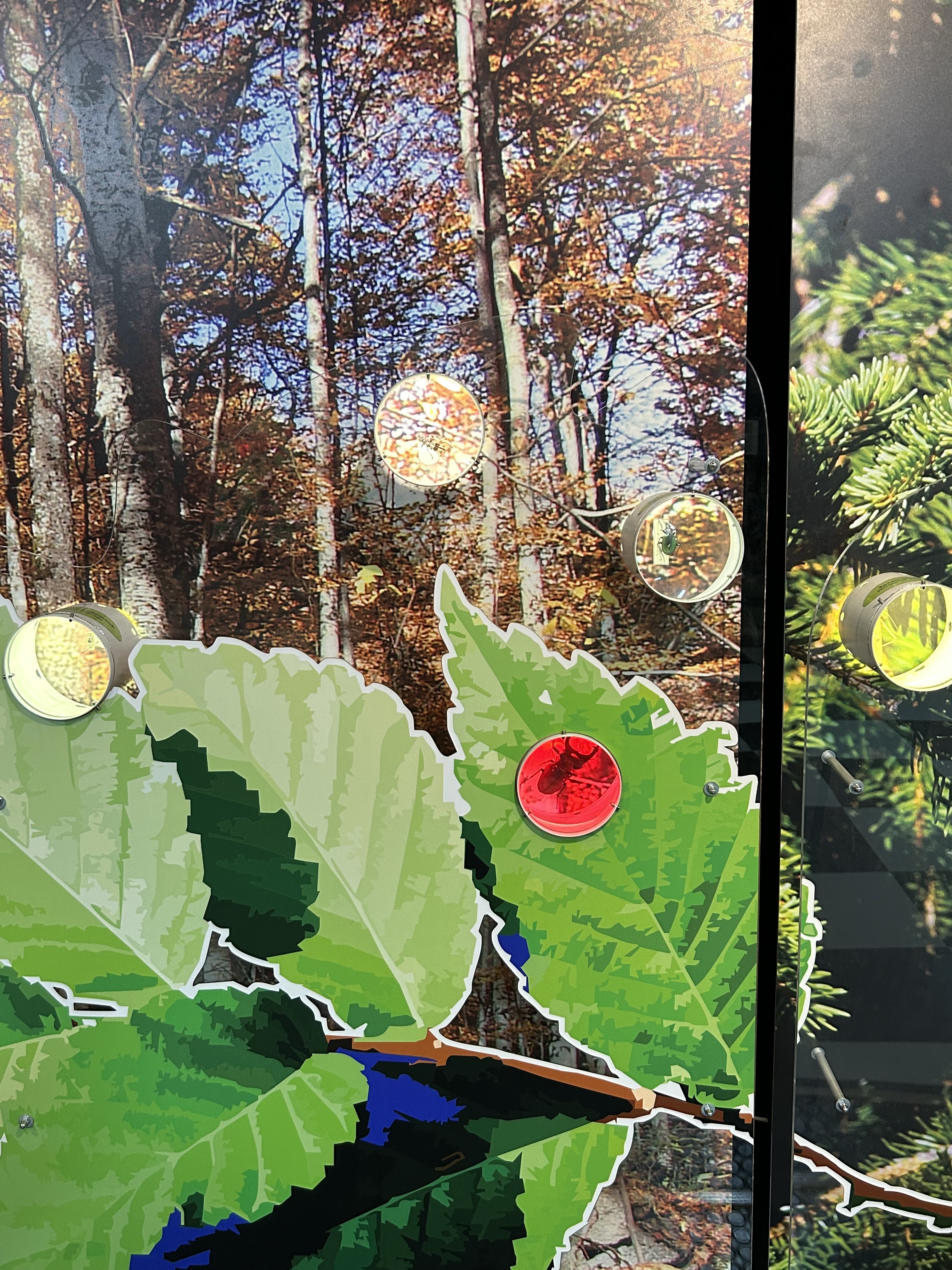
Inside this space is a fun gallery that puts insects found around Bulgaria in context by using large, colorful graphics representing different insect habitats. 


Throughout the space, you can also take closeup looks at representative insect specimens displayed in acrylic tubes.


Anchoring each section is a fanciful portrait of another representative insect species (including its scientific name!) like the dragonfly painting at the top of this post or the honeybee below.


While I wish the entire insect gallery was more like this one area, I realize that shifting a 130-year-old museum is a massive task. However, I give the staff, designers, artists, and fabricators kudos for finding a way to insert a bit of FUN and можело into the National Museum of Natural History.


P.S. to find out even more about FUN in museums, check out this wonderful YouTube interview with Christina Ferwerda and her colleague Helen Divjak!


Don't miss out on any ExhibiTricks posts! It's easy to get updates via email or your favorite news reader. Just click the "Sign up for Free ExhibiTricks Blog Updates" link on the upper right side of the blog.

Paul Orselli writes the posts on ExhibiTricks. Paul likes to combine interesting people, ideas, and materials to make exhibits (and entire museums!) with his company POW! (Paul Orselli Workshop, Inc.) Let's work on a project together!

If you enjoy the blog, you can help keep it free to read and free from ads by supporting ExhibiTricks through our PayPal "Tip Jar"

Monday, February 20, 2023

Back to Bulgaria!


I'm delighted that I will be heading back to Bulgaria to kick off the new MUSA Academy program sponsored by the America for Bulgaria Foundation (ABF).

The MUSA Academy will equip Bulgarian professionals from museums and other cultural organizations with the tools to create compelling exhibits and tell powerful stories that will keep visitors returning for more.

I am doubly excited to share the MUSA Academy teaching stage with colleagues Jamie Lawyer and Christina Ferwerda!

Check out this recent article from the ABF website that shares more information about my work and the new MUSA Academy.  Also, follow me on Twitter, Facebook, and Instagram as I post live updates from Bulgaria in March!


Don't miss out on any ExhibiTricks posts! It's easy to get updates via email or your favorite news reader. Just click the "Sign up for Free ExhibiTricks Blog Updates" link on the upper right side of the blog.

Paul Orselli writes the posts on ExhibiTricks. Paul likes to combine interesting people, ideas, and materials to make exhibits (and entire museums!) with his company POW! (Paul Orselli Workshop, Inc.) Let's work on a project together!

If you enjoy the blog, you can help keep it free to read and free from ads by supporting ExhibiTricks through our PayPal "Tip Jar"

Wednesday, October 2, 2019

10 Things I Learned As a Fulbright Specialist in Bulgaria


I recently returned from a wonderful extended trip to Bulgaria as part of the Fulbright Specialist Program.

During my work in Bulgaria, I engaged with staff and community partners at Muzeiko, the first children's science museum in Bulgaria (and the entire region, for that matter.)

While my primary purpose was to help build internal capacity at Muzeiko -- related especially to exhibit development, prototyping, and engaging with community partners, I also learned (or re-learned!) some things I think would be useful for anyone working to develop better exhibitions and programs at museums.


1) It helps to like the people you are working with enough to disagree with them
The core group of people I worked with (pictured at the top of this post) included museum staff from various departments at Muzeiko, community partners (including architects and specialists in "Escape Rooms") and Joe Cook, a lead exhibit developer from the German fabrication firm Huttinger.

We had fun together and worked hard bashing ideas around every day, but even though I was the ostensible "leader" of the process, there were a number of times that we were all not in lock-step agreement with how best to move forward.  And those disagreements (driven by passion for the work we were all doing) were an important part of the process.


2) Blocking off your calendars makes a big difference
Whenever I share my goals and expectations for a workshop, museum folks often say something along the lines of  "I don't think we will be able to do all that ..."  However, the fact that people have deliberately blocked off time on their calendars to meet with someone from the "outside" provides the luxury of large blocks of time uninterrupted by phone calls, emails, and the many tiny distractions that normally bog down a museum worker's day.


3) "Quick and Dirty" prototyping with simple materials (like paper and tape) is a great icebreaker!
People often resist the notion of prototyping by saying they don't have the time or money to prototype -- to which I instantly reply, "if you don't have time and money to prototype your exhibits, will you have time and money to fix your mistakes once you've installed your exhibits?"  Also doing fast and simple prototyping exercises with just paper and masking tape is a nice way to "break the ice" by introducing prototyping as a tool for building internal capacity.


4) Bring examples of prototypes, exhibits, and materials to the workshop!
When I travel to give workshops (even faraway to Bulgaria!) I usually pack two suitcases, one for my clothes, and one for my workshop materials, including prototype exhibit examples.  If a (PowerPoint) picture is worth a thousand words, an actual prototype device or exhibit material sample that workshop participants can touch and try out is worth at least ten thousand words!


5) Get out of the workshop room and out onto the exhibit floor!
More action, less talk about how to change/make/improve exhibits.  I learned a new Bulgarian word during this trip -- the Cyrillic spelling would be: Можело. (The English pronunciation would be: Moj-e-lo.)  Basically, my sense of the word is "we can do this!" or "this can be done!" Exactly the right attitude for prototyping!


6) Get feedback early and often from visitors.
Forget about what you and I may think about these exhibit ideas, what do visitors think?  The only way to find out is to get your ideas and prototypes in front of visitors as soon as you can.


7) Don't forget the index cards (and whiteboards, and scissors, and tape ...)
Prototyping is a way of "thinking with your hands." But if you don't have some materials to think and tinker (thinker?) with your creative momentum will often stall -- so connect with your workshop hosts to make sure you have good access to tools and materials (even if you have to pack your own index cards!)


I really like using whiteboards for workshops more than those big paper easel pads -- they're reusable and taking pictures of each whiteboard before they are erased provides easy images to drop into follow-up reports (or blog posts!)


8) You can prototype graphics and labels, too.
In my opinion, you can prototype anything in your museum -- not just exhibit components, but also educational programs, computer games, graphics ...


9) Cast your nets wide.
Look for ways to amplify and spread your message during your workshops.  In my case, I was fortunate to also be able to present a workshop to museum professionals from all around Bulgaria, while in Sofia.


10) Learn from people and places outside your workshop rooms!
I have been fortunate to visit Bulgaria several times -- I'd happily suggest a visit there to anyone! (Raise your seats and stow your tray tables, because this is the travelogue section of this post.)

During my most recent trip, I spent some time in Plovdiv, Bulgaria's second-largest city.  Plovdiv is a cool combination of a modern city, a beginner's parkour course (tons of steps, hills, and steep slopes) and restored Roman artifacts and structures -- all intermixed with each other!


While I was in Plovdiv, I got to visit the construction site of a massive Roman Basilica project filled with amazing mosaic floors from the Fourth Century! I imagine after the project opens it will be a candidate to be named a UNESCO World Heritage Site.


To finish up my trip with a massive dose of culture shock, I attended ComicCon in Sofia it was amazing to see worldwide pop culture viewed through a Balkan lens!


One last picture (and tip!) "Eat where the locals eat!" Here I am with some of my Bulgarian friends at a Turkish restaurant inside a Bulgarian truckstop.


THANK YOU, THANK YOU, THANK YOU to both the Fulbright Specialist Program and my excellent colleagues at Muzeiko for making my trip and workshops possible!


Don't miss out on any ExhibiTricks posts! It's easy to get updates via email or your favorite news reader. Just click the "Sign up for Free ExhibiTricks Blog Updates" link on the upper right side of the blog.

Paul Orselli writes the posts on ExhibiTricks. Paul likes to combine interesting people, ideas, and materials to make exhibits (and entire museums!) with his company POW! (Paul Orselli Workshop, Inc.) Let's work on a project together!

If you enjoy the blog, please help support ExhibiTricks through our PayPal "Tip Jar"

Tuesday, August 27, 2019

Off to Bulgaria!

Muzeiko Building Exterior

Through an award from the U.S. State Department's Fulbright Specialist Program, I'll soon be off to Bulgaria to work with wonderful colleagues at Muzeiko, the amazing children's science museum located in the capital of Sofia.

My work in Bulgaria will focus on increasing internal capacity at Muzeiko, especially as it relates to exhibit design and development.

If you'd like to keep track of my trip and what I learn in Bulgaria, check out my Twitter, Facebook, or Instagram pages!


Don't miss out on any ExhibiTricks posts! It's easy to get updates via email or your favorite news reader. Just click the "Sign up for Free ExhibiTricks Blog Updates" link on the upper right side of the blog.

Paul Orselli writes the posts on ExhibiTricks. Paul likes to combine interesting people, ideas, and materials to make exhibits (and entire museums!) with his company POW! (Paul Orselli Workshop, Inc.) Let's work on a project together!

If you enjoy the blog, please help support ExhibiTricks through our PayPal "Tip Jar"

Sunday, October 25, 2015

How I Helped Open The First Children's Museum In Bulgaria, And What I Learned In The Process


Muzeiko, the first Children's Museum in Bulgaria (and really the first truly interactive museum in that entire part of the world ...) opened officially on October 1st, 2015.  Having been involved in the entire development process of Muzeiko for the past few years (and even before the official Muzeiko project started!) has certainly been one of the highlights of my museum career so far.

People often ask how I ever got involved in a museum project in Bulgaria, and what I've taken away from the whole experience.

The story starts in 2007 when I was presenting at the annual Association of Children's Museums (ACM) conference in Chicago.  After one of my talks, an energetic young woman strode up the aisle and introduced herself to me.  "My name is Vessela Gertcheva" she said.  "I'm from Bulgaria, and I want to start a Children's Museum there, since we don't have anything like that in my country.  When we start the project I hope you can work with us."

That's Vessela!
At that point I had never even met anyone from Bulgaria, and I was taken with Vessela's enthusiasm.  We exchanged business cards and agreed to stay in touch.   After Vessela walked away, I thought, "I'm never going to see that woman again.  How am I ever going to end up in Bulgaria?"

So, one of those pleasant serendipitous conference encounters, but that's that, I thought.

Little did I realize that I would receive an email in the Fall of 2009 inviting me to come to Bulgaria to help Vessela work on a pilot project with the New Bulgarian University to develop "Children's Corners" (really small interactive exhibitions geared toward children and families ) in five existing museums throughout Bulgaria. A series of email exchanges commenced, and then along with two wonderful colleagues, Deborah Edward and Sally Yerkovich,  I made my way to Bulgaria in November 2010 for a whirlwind tour of the various museum sites and many meetings with Bulgarian museum professionals and educators to kick the process off.


Deborah Edward and myself at the New Bulgarian University


SIDE NOTE: If you have have the chance to visit Bulgaria, GO!  It is an amazing country filled with friendly people, great food, amazing natural and cultural sites, including a number of UNESCO World Heritage Sites, like the Rila Monastery up in the mountains.


Rila Monastery


After my initial visit to Bulgaria for the Children's Corners project, I continued to stay in touch with Vessela and offer advice remotely (and even help to coordinate the occasional shipment of materials to Sofia.)  Needless to say the Children's Corners were a big hit!  I was so touched when Vessela sent me a picture of the first anniversary of the opening of the exhibition at the museum in Blagoevgrad --- school children dressed up, sang songs, and even made a cake for the Children's Corner there!


Children's Corner Celebrations in Blagoevgrad!

With the Children's Corners being so successful, The America for Bulgaria Foundation issued an international call for proposals in early 2012 to create the building and exhibitions for a new Children's Museum in Sofia, the capital.  I was part of the proposal with the talented team at Lee H. Skolnick Architecture + Design Partnership in New York, and we won the competition!


Me with part of the Skolnick team in the Sofia Metro

What followed from the middle of 2012 right up until the opening of Muzeiko in 2015 were meetings (both in person in Sofia and New York) as well as flurries of emails and Skype calls to keep everything moving forward.  It truly was a mutually respectful creative partnership between the Bulgarian team and the American team, which I think shows in the final incarnation of the Muzeiko project.

So after nearly four years of planning, prototyping, building (and yes occasionally arguing!) about what would end up inside (and outside!) Muzeiko, I was able to fly to Sofia with my wife to attend the fancy Grand Opening party during the evening of September 30th, 2015.  It was awesome!  Boyko Borissov, the Prime Minister of Bulgaria was there, as well as the American Ambassador, and the Mayor of Sofia.   Ribbons were cut, and a marching band played.  A choir group even sang a special Muzeiko anthem!   It was tremendously gratifying to see years of ideas and passion and hard work come to fruition!  Also, since Muzeiko is the first museum of its kind in the entire Balkan region, I am sure it will have a tremendous impact on the lives of families, children, and educators throughout Eastern Europe.


Bulgarian Spiderman inside Muzeiko!

So what did I learn from my Bulgarian museum adventure?  Three main things:


• Always be open to expanding your museum network 
If I hadn't met Vessela during the ACM Conference in Chicago and stayed in touch afterwards I would have never ended up in Bulgaria.  To me, networking should not be a strictly "quid pro quo" arrangement (what can this person do for me, right now?) but rather an ongoing professional relationship of mutual interest.

• Prototype and pilot!
I'm sure the Muzeiko project is stronger because of the things that were learned from the Children's Corners pilot projects, and the extensive exhibit prototyping (and "soft opening" days) that all happened.  As with most projects, I wish we had done even more prototyping, but the Muzeiko teams really were concerned about trying things out ahead of the formal opening.

• Choose strong creative partners!
I couldn't have asked for better creative partners than the Skolnick team and our Muzeiko counterparts in Bulgaria.  Smart and nice makes a great combination. I always felt that everyone was putting forth their best efforts with a clear shared end-goal in mind.  In the end, I feel that people get the creative partners they deserve --- a creative relationship, like any relationship, needs to be able to survive the occasional bumps in the road.  I want to make sure my creative partners are proactive problem solvers, not finger-pointing whiners.


Muzeiko will always be a special museum project for me.  And I'll continue to use it as a benchmark for future work. Lucky me!

If you'd like to learn more about Muzeiko, check out their website (parts in English!) or this nifty Google virtual walk-through the entire Muzeiko building!


Happy Creative Partners at the Muzeiko Opening


Don't miss out on any ExhibiTricks posts! It's easy to get updates via email or your favorite news reader. Just click the "Sign up for Free ExhibiTricks Blog Updates" link on the upper right side of the blog.  Looking for a great creative partner for your next project? Let's talk!  Email me to get the conversation started.

P.S. If you receive ExhibiTricks via email (or Facebook or LinkedIn) you will need to click HERE to go to the main ExhibiTricks page to make comments or view multimedia features (like videos!)