Showing posts with label Welcoming Museums. Show all posts

Thursday, December 21, 2023

Museums and Restaurants


As the end of the year festivities approach, I'll be spending time with my extended family. We will no doubt be enjoying many wonderful new museum and food-related experiences, so I thought I'd share this "encore" of one of my most popular posts that ties together the similarities between great dining AND great museum experiences.

ENJOY! 

Let me tell you about Bigelow's.  It's a little "hole in the wall" sort of place near my home on Long Island known for its fried clams. Bigelow's has been in business in the same spot since 1939.  I went there for lunch today with my son, Philip, and in between our sighs of pleasure and chatting it up with our fellow diners, I was reminded of how much a great dining experience is like a great museum experience.

1) Everyone Knows Where It Is

I know you can use Google Maps or Yelp, but if you ask somebody at a hotel front desk or a taxi driver where a local restaurant or museum is, they should be able to tell you right away. If the place is really good, they should also be able to enthuse about a memorable experience that they or a friend had there recently.  I remember visiting a city whose (unnamed) museum was practically across the street from the well-known professional football stadium, and not one taxi driver knew where that museum was located or had even heard of it.  That's sad.

2) You Feel Welcomed Right Away

Even if it's the first time you've been there, a great museum or dining spot makes you instantly feel welcomed and at ease.  It's a combination of the physical entry sequence (starting in the parking lot) and the staff people at the entrance that do the trick. You feel like you are in the right place and are starting out your visit in a positive way.  Think about the qualities of the places that always make you feel welcomed (and the ones that don't!)

In the case of Bigelow's, you see the stools around the horseshoe-shaped counter (so you know where to sit right away) and the straightforward menu board lets you see your options (so you can start thinking about what you'd like to eat or drink as soon as you sit down.)  

Contrast that with some museums where you have no idea where to pay your admission, or how to figure out which things you want to do or pay for.

Welcome to Bigelow's!

3) Friendly Staff Anticipate Your Needs

You never wait for your water glass to be refilled, or twiddle your thumbs waiting for the check at a great restaurant. That's because the people who work there are alert and genuinely attentive to their customers' needs.  Great museums have actual floor staff interacting with visitors, not just chatting in a corner by themselves.  Wonderful dining and museum experiences share an important social component.  A positive interaction with a staff person often adds to the overall experience.


4) You Tell Friends About The Place And Want To Take Them There

A fantastic experience at a great place is one you want to share with other people. There's a reason "word of mouth" advertising is so sought after --- you can't fake it or spend your way there.  If you had a remarkable museum experience you tell other people about it.  And you want to go back there to share that positive experience with people you care about.  I've visited "museums worth a special trip" --  those places you would travel out of your way to go see based on a friend's recommendation.  I would definitely put places like The City Museum in St. Louis, or Chanticleer Garden outside Philadelphia in that rarefied category. 

Bigelow's is worth a special trip!

5) Memory Makers!

The best museums (and restaurants!) are memory makers.  They are the places that are part of every story that starts with "Remember the time we ..."  They are the places that you want to post on Facebook or Instagram because you felt the experience was worth capturing and sharing.  The picture at the top of this post shows my friends Bistra and Nadia from Bulgaria after a lunch we shared at Bigelow's.  They asked for me to bring them somewhere that was real "Long Island."  And even though they both grew up thousands of miles away, they loved it!  And what business can ask for more than that?

As you are starting out your New Year and thinking about ways to improve the museum(s) you work with and for, maybe a trip to your favorite local restaurant can give you just the right kind of "food for thought" to inspire making some memorable changes for your visitors. Cheers!

Instagram-ready "food for thought" from Bigelow's!


Don't miss out on any ExhibiTricks posts! It's easy to get updates via email or your favorite news reader. Just click the "Sign up for Free ExhibiTricks Blog Updates" link on the upper right side of the blog.

Paul Orselli writes the posts on ExhibiTricks. Paul likes to combine interesting people, ideas, and materials to make exhibits (and entire museums!) with his company POW! (Paul Orselli Workshop, Inc.) Let's work on a project together!

If you enjoy the blog, you can help keep it free to read and free from ads by supporting ExhibiTricks through our PayPal "Tip Jar"
Wednesday, March 9, 2016

Margaret Middleton on Family Inclusion in Museums

                                                       (Photo Credit: Matthew Clowney)

Margaret Middleton is a Boston-based exhibit developer and designer. A museum geek and queer activist, she has spoken all over the country about the importance of family inclusion in museums. Most recently Margaret produced Mimi's Family: Photography by Matthew Clowney, an art exhibit for children featuring a family with a transgender grandparent.  

We are happy to welcome Margaret back to ExhibiTricks to share her thoughts on making museums more welcoming places for diverse families.


What does family inclusion mean?

Families make up 40% of all museum audiences (American Alliance of Museums, 2006 Museum Financial Information).  “Family” is meant to refer broadly to intergenerational learning groups, but all too often it becomes a code word. We often use “family” to mean a nuclear family with two heterosexual, legally married parents of the same race and their biological children, residing in the same household. 

According to Strong Families, “4 out of 5 people living in the US … do not live behind the picket fence—[their] lives fall outside outdated notions of family, with a mom at home and a dad at work.” Museums who aren’t actively engaging families who don’t fit that codified definition aren’t serving the majority of families.

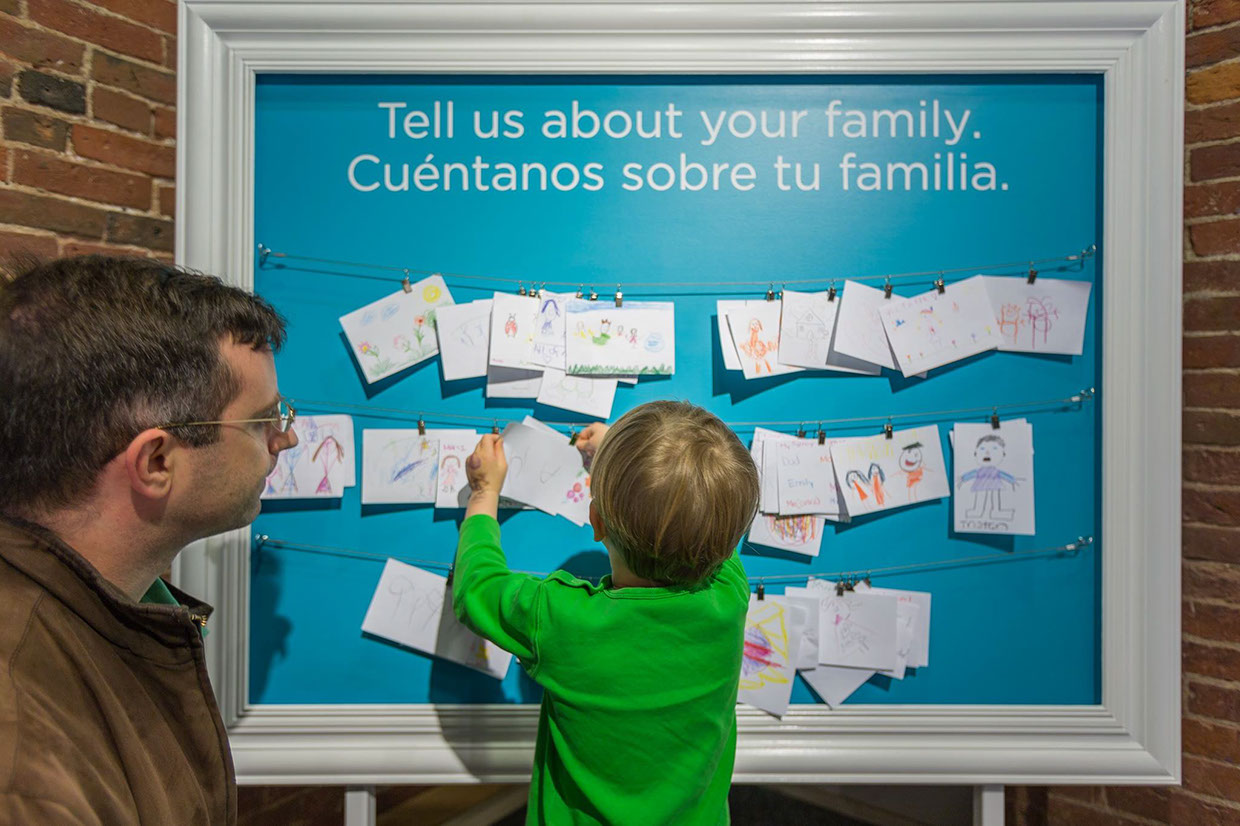
Family inclusion is about actively welcoming diverse families in museums.


How can museums accommodate a greater diversity of families?

Representation
Just as you strive to incorporate racial diversity in your signage and marketing, make sure that visual depictions of families in your museum are varied. Include single parents, same-sex parents, multi-racial families, and multiple generations. If you have a reading nook, populate it with books that show many kinds of families. This is a good list to start with.

Seating
One of the subtle ways museums signal the type of family they expect is through seating. Instead of fixed benches or square tables with four chairs, try modular seating that is easily moved and reconfigured by visitors to accommodate a variety of families. Make sure to include several seating heights to accommodate visitors of different sizes. Bean bag chairs are fun but they are tough for older folks and anyone with mobility issues. If you use bean bags, make sure there are more accessible options available too.

Bathrooms
Gender inclusive bathrooms can meet the needs of transgender and nonbinary family members or anyone else who may not feel comfortable or safe using gender-segregated restrooms. They are often single-stall and accessible so they can accommodate wheelchairs, strollers, and anyone who needs assistance in the bathroom, including children. They often have changing tables too (which should also be present in both men’s and women’s restrooms).

Unfortunately, signage for gender inclusive bathrooms often reads “Family Bathroom” and depicts a family like this:


Opt for a more inclusive sign like this:


All-Gender Restroom sign available at: mydoorsign.com 


Family memberships
Make sure your policies fit your expanded definition of “family.” Instead of defining a family membership as a membership for two adults and their children, offer flexible memberships that accommodate families with any number of adults and children and charge accordingly. This makes room for single caregivers and families with more than two adults in them. 

Do away with mandatory gendered honorifics like Ms. and Mr. and instead of “mom,” “dad,” or “parent” categories, simply use the word “adult.” Family memberships should not be limited to “members of a household” so as not to leave out families that live apart like divorced families or families with hired caregivers.


What’s a good place to begin?

Museums are not exactly known for being nimble when it comes to change. If you’re not a top decision maker at your museum, policy and infrastructure changes may be harder for you to influence. One of the easiest (and cheapest!) ways to cultivate an institutional culture of family inclusion is to start expanding your museum’s definition of family through language.

Host a brown bag lunch to discuss the meaning of the word “family.” You can also use the Family Inclusive Language chart I created (below) to talk about the assumptions we make about our visitors and how to avoid embarrassing and even hurtful interactions. The new words you choose will change the way you greet visitors at the admission desk, give tours, write label copy, compose tweets, and update the Facebook page.

These language shifts are simple, but don’t mistake them for being superficial. Words have power. In fact, according to cognitive scientist Lera Boroditsky, “Studies have shown that changing how people talk changes how they think.” You actually have the power to challenge your own implicit bias.

A few carefully chosen words can go a long way in helping visitors feel more welcome in your museum. Start with language, and before long it will be even easier to make the case for further change.


You can follow Margaret on Twitter @magmidd. To see Margaret’s work and to learn more about her family inclusion workshops, visit her website. Family Inclusive Language posters can be ordered here: zazzle.com/magmidd 


Don't miss out on any ExhibiTricks posts! It's easy to get updates via email or your favorite news reader. Just click the "Sign up for Free ExhibiTricks Blog Updates" link on the upper right side of the blog.


P.S. If you receive ExhibiTricks via email (or Facebook or LinkedIn) you will need to click HERE to go to the main ExhibiTricks page to make comments or view multimedia features (like videos!)