Friday, April 6, 2018

Back to Tunisia!


I'm off on another museum project  --- this time for my second trip to Tunisia!  I'll be reporting on my Tunisian travels in a future ExhibiTricks blog post, but for now I hope you'll enjoy this "encore" post about my first trip to Tunisia.  You can also check out my Twitter, Facebook, and Instagram feeds for live updates!


My work brings me to many unexpected places around the world, but I just returned from what may be my most interesting trip so far --- working with folks from Libya, but in Tunisia!

So how did I end up in Tunisia?  Earlier this year, I was contacted by Professor Susan Kane of Oberlin College.  Susan told me about her project through the Bureau of Near Eastern Affairs, U.S. Department of State to work with Libyan educators, scout leaders, and museum folks.

The point of this particular project being to bring together Libyans from different parts of the country who work with young people to help foster national reconciliation, and to create a greater appreciation for the importance of Libyan cultural heritage --- both tangible (think historic structures and archaeological sites) as well as intangible (things like music, dance, and poetry.)

Now we need to stop the story to fill in a couple of important details.  First off, given shifting events and unrest in Libya over the past few years, our U.S. Embassy to Libya is currently located in neighboring Tunisia, not Libya (see map below.) So that's why a State Department workshop with participants from Libya was happening in Tunisia.  (Also U.S. citizens are currently advised not to travel to Libya.)


Secondly, why ask ME to give this workshop that, at least partially, concerned itself with cultural heritage and Libyan national reconciliation?  Several kind museum colleagues pointed Susan in my direction, and together we crafted a plan to share my ideas about open-ended activities for children, quick and cheap exhibit prototyping, and developing pop-up or temporary museums in schools and community centers with the workshop participants.

After the initial excitement of traveling to Tunisia wore off, I honestly began to worry --- would my information and activities with simple materials actually be useful to Libyans concerned with reconciliation and cultural heritage? I continued to think about this from the time I started planning activities and gathering materials in the U.S. all the way until I arrived at the hotel on the outskirts of Tunis where the workshops would be held.

Fortunately, the Libyan men and women in my workshop were very enthusiastic and welcoming.  It was clear (once we got into the groove with our helpful translators!) that everyone at the workshop was hungry for activities to share with the students, scouts, and children they worked with.  I deliberately chose topics and activities that I thought could be used in a wide range of situations.


For example, I introduced a number of activities that dealt with the topic of "Structures."  In dealing with open-ended design challenges involving structures we could easily discuss History, Architecture, and Engineering among other subjects.  We created bridges and buildings out of simple supplies like paper, tape, straws, and paper clips.  The workshop participants excitedly shared their own embellishments for activities with each other, and also remarked on the symbolic value of a topic like "bridges" when discussing with children how to work together to create a more united Libya.  (Given the current political climate, maybe I should introduce more bridge-building activities for my workshops in the United States!)


Together with the workshop participants we spent one day focused on how to develop open-ended design activities and another on testing and prototyping ideas. Along the way, I also introduced fun activities like "Laughing Cups" that could quickly engage children and then lead into a broader discussion of cultural heritage topics like Music. (My new Libyan friends in the workshop called these sorts of activities Mr. Paul's "tricks.")

Our last workshop day together dealt with the development of Pop-Up (or temporary) Museums. These sorts of temporary displays or exhibitions are great ways to engage with communities and lend themselves to being set up inside non-museum spaces like schools or community centers (or even under tents outside.)  So we ended our workshop by creating a Pop-Up Museum!


Several workshop participants brought objects from home to share for the Pop-Up Museum, while others put displays together from materials available on-site.  One of my favorite examples of "instant exhibitry" was from Intisar, the director of the Children's Museum in Tripoli, who created a display about the different types of historical tombs found in Libya (clay for lower class, glass for upper class) using leftover chicken bones from lunch and an ashtray from her hotel room!


As with every class or workshop I lead, I learned a lot from the participants and our work together. Perhaps foremost in Tunisia, I learned that the Libyans I met (like all people around the world) want a better life for their children, and a safe and secure place to live.

So can Laughing Cups help Libya? In the hands of the thoughtful and dedicated people I met in Tunisia, I'm sure, in a small way, they can.


Don't miss out on any ExhibiTricks posts! It's easy to get updates via email or your favorite news reader. Just click the "Sign up for Free ExhibiTricks Blog Updates" link on the upper right side of the blog.

P.S. If you receive ExhibiTricks via email (or Facebook or LinkedIn) you will need to click HERE to go to the main ExhibiTricks page to make comments or view multimedia features (like videos!)

Friday, March 30, 2018

Are There Hidden "Easter Eggs" In A Museum Near You?


I'm away in Paris for Easter, so I thought ExhibiTricks readers might enjoy this seasonal post!

You can also check out my TwitterFacebook, and Instagram feeds for live updates from Parisian museums and exhibits!

Museum designers often add "Easter Eggs" to their work.  But not the brightly dyed or chocolate-y varieties --- these are more akin to the hidden "Easter Eggs" that you may stumble across (or deliberately search out) inside video games, crossword puzzles, or DVDs.

For visitors, it's fun to feel like you've found a little "secret" inside a museum building or exhibition, and for designers it's a little "trick" to reward visitors for carefully observing and examining things inside the museum.

"Exhibits as advent calendars" as Dan Spock has observed (to mix religious holiday metaphors a bit!)  So here are a few of my favorite museum easter eggs:


• Secret Elves at the Denver Museum of Nature and Science: Artist Kent R. Pendleton worked on many of the Museum's dioramas, but supposedly he wasn't allowed to sign his name to his work.  Instead, Pendleton included little "elfin" figures hidden throughout many of the displays.  There's a great blog posting (with video) about Pendleton's retro easter eggs!


• The Magic House Mouse:  The "Magic House" Children's Museum outside St. Louis has some wonderful exhibits, but one of my favorite "hidden gems" is the tiny decorated mouse hole near the baseboards in one of the galleries.  If you were just whizzing around you might not ever see it, but if you're willing to get down on your hands and knees you might see (as in the photo below) a "presidential" mouse:


• The "Hidden Tunnel" at Casa Loma:  Casa Loma is a gigantic historic house outside Toronto that is filled with enough crazy details to keep even little kids interested during the self-guided tours.  One  of the things I remember from a family visit (nearly 40 years ago!) was the cool secret tunnel, nearly 100 feet long, that was hidden behind a pivoting wall section (just like in all those scary movies --- but this was real!)  that led to the Casa's underground wine cellar:


Of course some museums, like The City Museum, also in St. Louis, or the Museum of Jurassic Technology in L.A., are practically interlocking collections of "easter eggs" or in-jokes, but that's certainly one aspect that makes them so popular.

What are some of your most memorable "Museum Easter Eggs"?  Let us know in the "Comments Section" below!

Don't miss out on any ExhibiTricks posts! It's easy to get updates via email or your favorite news reader. Just click the "Sign up for Free ExhibiTricks Blog Updates" link on the upper right side of the blog.

P.S. If you receive ExhibiTricks via email (or Facebook or LinkedIn) you will need to click HERE to go to the main ExhibiTricks page to make comments or view multimedia features (like videos!)

Friday, March 23, 2018

Exhibit Design Inspiration: Brad's Grocery Store Vegetable Displays


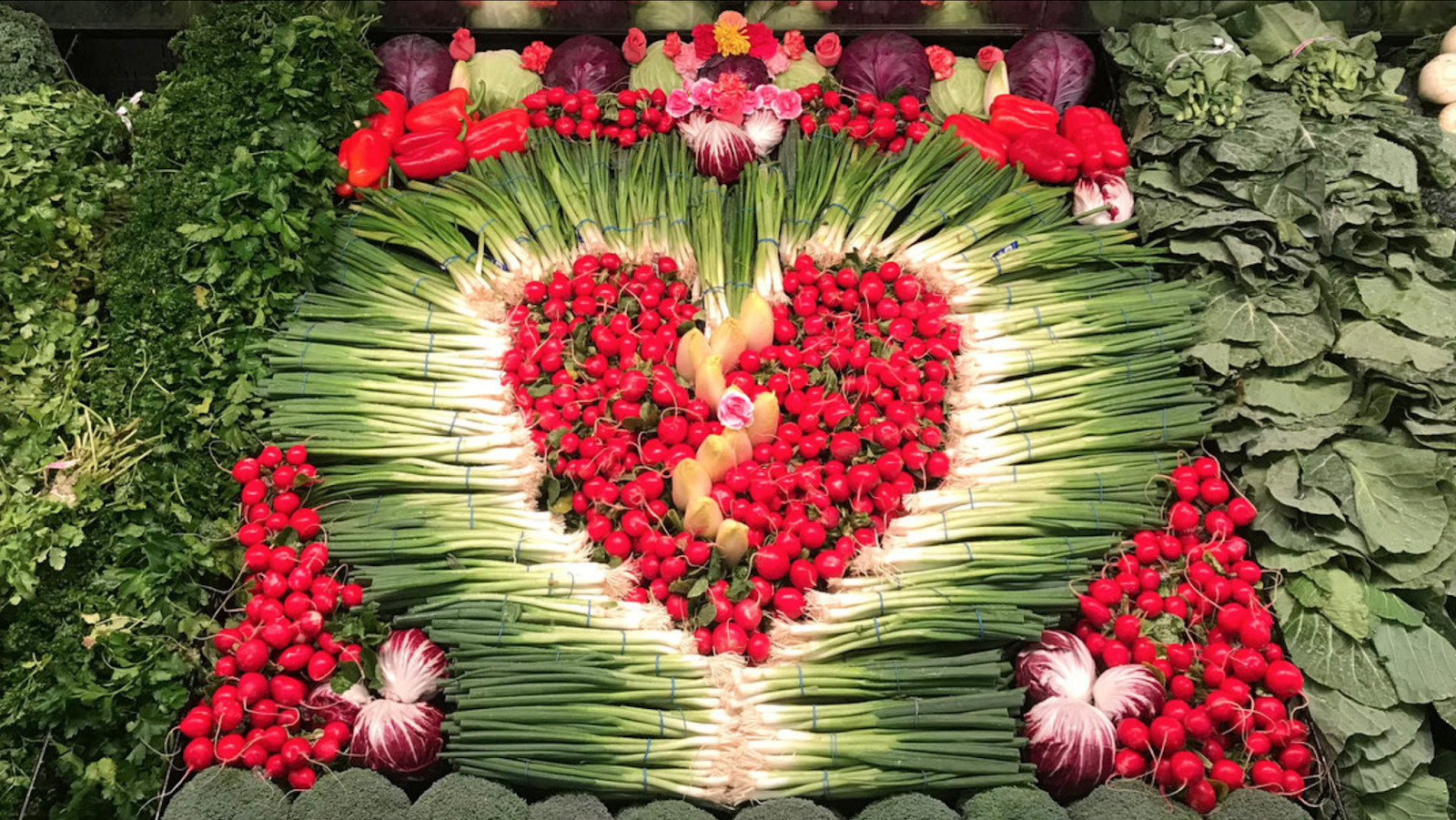
You have to admire someone who takes a "simple" job and turns it into a creative outlet.  Such is the case with Brad, a semi-anonymous grocery store worker from the city of Madison in Wisconsin.

I came across Brad's story, and examples of his work, through the food-related offshoot (called "Gastro Obscura") of the website Atlas Obscura.

For Pi Day!
One thing that resonated for me about Brad's vegetable creations was how he took a task that might have seemed mundane or even drudgery and turned it into a positive creative outlet.  I think there's a good inspirational lesson there for any museum/exhibit/design worker!

I also appreciated how positive customer feedback pushed Brad to keep up with his creative vegetable displays.  To quote Brad:

Compared to past jobs, “doing this work was the first time people would stop, smile, and give me nice comments on the beauty of my work.”

So as you move through your own creative tasks and challenges, take some time to find the beauty in your own endeavors.

Check out the Gastro Obscura article about Brad, and follow him on Instagram to see even more examples of his vegetable artistry.


Don't miss out on any ExhibiTricks posts! It's easy to get updates via email or your favorite news reader. Just click the "Sign up for Free ExhibiTricks Blog Updates" link on the upper right side of the blog.

P.S. If you receive ExhibiTricks via email (or Facebook or LinkedIn) you will need to click HERE to go to the main ExhibiTricks page to make comments or view multimedia features (like videos!)

Tuesday, March 13, 2018

A Book For Everyone Who Works With Creative People


It's somehow always surprising to me that not everyone who runs a museum works well with creative people.

Bonnie Siegler's new book,  Dear Client: This Book Will Teach You How to Get What You Want from Creative People, may well be the perfect gift for those folks struggling to get the best results out of their creative relationships.

The tone of the book is set from the very first quote, attributed to Steve Jobs: "It doesn't make sense to hire smart people and then tell them what to do; we hire smart people so they can tell us what to do."

In a visually compelling presentation, Siegler, a graphic designer, lays out 66 pithy tips for working with creative people.  

Here are a few of my favorites:

No. 5  Have Clarity of Purpose

As Siegler mentions in her book, if you have more than three priorities, you really don't have any.

No. 8  Decide Who Will Decide

Creative vision is NOT a group activity. Choose one person who will be the decider and/or tie-breaker.

No. 20  Be Up Front About Money

Trust us with your budget parameters --- it will make us feel like we're on the same side.

No. 49  Don't Let Data Drive Your Decisions

I love what Siegler says here -- data doesn't leave room for the most unquantifiable of qualities: vision.  

People will always respond to the familiar in a way that can be recorded.  But how do you crunch the numbers on something new and remarkable?


In fact, you may want to purchase two copies --- one for yourself, and one for your next client!


Don't miss out on any ExhibiTricks posts! It's easy to get updates via email or your favorite news reader. Just click the "Sign up for Free ExhibiTricks Blog Updates" link on the upper right side of the blog.

P.S. If you receive ExhibiTricks via email (or Facebook or LinkedIn) you will need to click HERE to go to the main ExhibiTricks page to make comments or view multimedia features (like videos!)
Wednesday, March 7, 2018

Small Spaces in Big Museums


On a recent visit to the Museum of Fine Arts (MFA) in Boston with my family, it wasn't just the big exhibition galleries and art that impressed me, but also some smaller, more intimate, exhibition spaces.

In particular, the Musical Instruments gallery was a perfect "right-sized" museum experience.  As you can see by the section of museum map from the MFA below, the space is barely bigger than the nearby ticketing desk area.


However, while small, every aspect of the Musical Instruments gallery was polished to jewel-like perfection.

To begin with, the space was slightly off the main entrance and easily missed if you were rushing into some of the special exhibition galleries.  Unlike most of the galleries in the MFA, Musical Instruments was sealed by a heavy glass door that blocked out the sound from the rest of the museum.  This was highlighted by the soft music playing inside the gallery --- very appropriate considering the subject of the gallery's contents!

The instruments on display were unusual and interesting (like the ceremonial trombone pictured at the top of this post) and because the space was small, with only a few other people inside, it rewarded careful observation and concentration.  Minute details that might otherwise be glossed over in the hustle-and-bustle of larger MFA galleries, were instead admired and appreciated.


The Musical Instruments gallery experience felt like an exhibit oasis in the middle of the MFA.  As a visitor, I appreciated the respite and felt recharged to explore some of the bigger, busier galleries.

So here's to small museum spaces!  How might you add a small or quiet moment to your museum or to your next exhibit project?


Don't miss out on any ExhibiTricks posts! It's easy to get updates via email or your favorite news reader. Just click the "Sign up for Free ExhibiTricks Blog Updates" link on the upper right side of the blog.

P.S. If you receive ExhibiTricks via email (or Facebook or LinkedIn) you will need to click HERE to go to the main ExhibiTricks page to make comments or view multimedia features (like videos!)

Monday, February 26, 2018

Making Math (More) Fun for Museum Visitors


As I've been working on exhibit installations and new museum building (re)opening at The Discovery Museums in Acton, MA, I've been thinking about how to present and interpret different bits of content -- like MATH.

Lots of people claim to "hate" math topics, but I've recently fallen down the rabbit hole of Numberphile, a great math-oriented website and related YouTube channel filled with all sorts of clever ideas that should be of interest to educators and exhibit designers alike.

One of the things I like best about the Numberphile videos is that each mathematician is so enthusiastic, you can't help but get excited and interested in things like "circle inversions" that you might not have even given a passing thought to before.

While I've honestly enjoyed every Numberphile presenter I've seen, some are particular standouts.

Tadashi Tokieda often relates his math talks to toys or familiar materials.  Here's a video (embedded below or on YouTube) that shows all the fun topological ways to play with a strip of paper, some paper clips, and rubber bands.


Hannah Fry is a funny presenter who often ties the mathematics of game theory to real life situations like winning Rock, Paper, Scissors (video below or on YouTube) or Secret Santa, or making the best online dating profile.


If you are a bit "math shy" or even an avowed mathphobe, click on over to Numberphile!  I'm sure you will find something to pique your interest there.


Don't miss out on any ExhibiTricks posts! It's easy to get updates via email or your favorite news reader. Just click the "Sign up for Free ExhibiTricks Blog Updates" link on the upper right side of the blog.

P.S. If you receive ExhibiTricks via email (or Facebook or LinkedIn) you will need to click HERE to go to the main ExhibiTricks page to make comments or view multimedia features (like videos!)